The energy market: where do we stand in mid-June 2026?
6 min | 15 June 2026
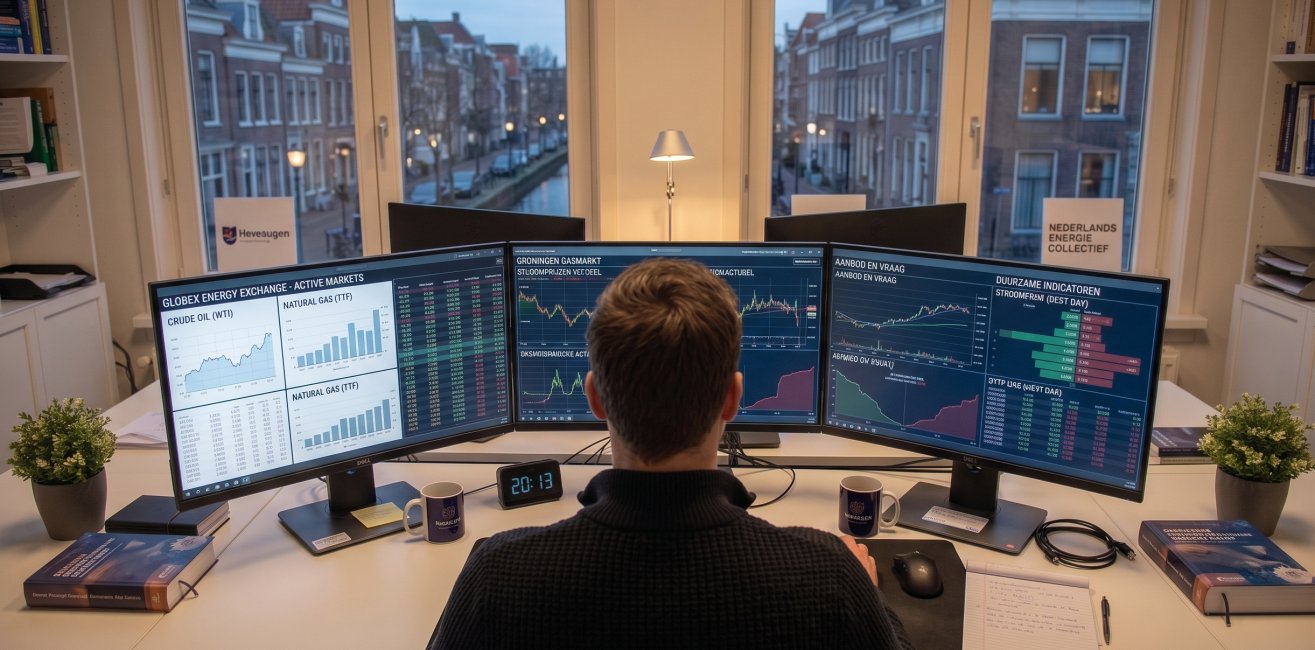
The energy market moves fast and remains hard to predict. Price falls can reverse within a short time, while geopolitical developments, stocks and supply routes continue to influence the market. In this update we set out the key signals and give direction to organisations that want to steer their energy procurement more deliberately.
Jump straight to:
The hard figures
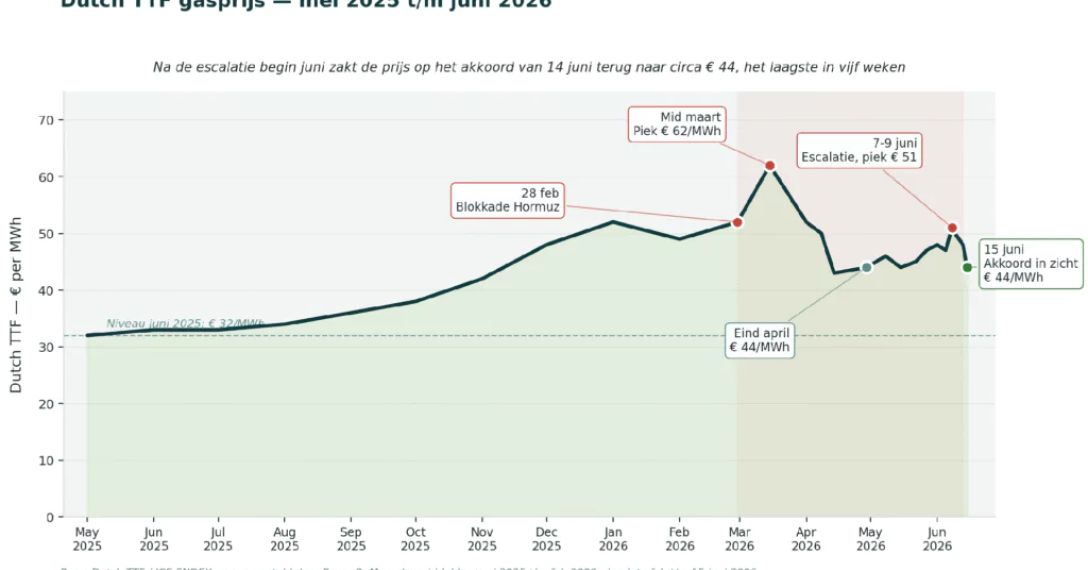
The energy market has had an erratic week and a half, with an important turn at the end of it. At the start of June the tension around Iran was still rising: on 7 and 8 June Israel and Iran exchanged direct missile attacks for the first time since April, and after an American military helicopter was brought down over the Strait of Hormuz, American retaliatory strikes followed. Dutch TTF peaked above €51/MWh. On 14 June, however, came the news the market had been waiting weeks for: the mediator Pakistan announced that the United States and Iran had reached an agreement to end the conflict, including the lifting of the American blockade and the reopening of the Strait of Hormuz.
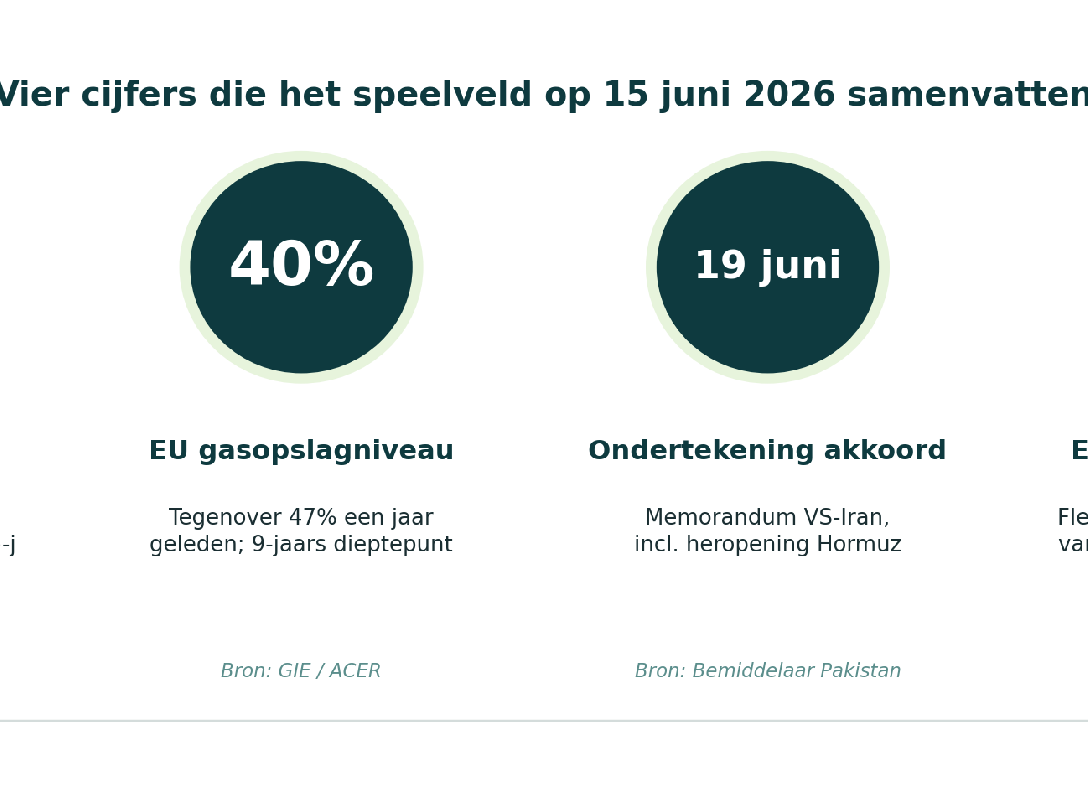
On that news the gas price fell by more than five per cent on 15 June to around €44/MWh, the lowest level in five weeks. At the same time the picture for large energy users remains nuanced: the agreement will not be formally signed until 19 June, shipping through Hormuz has yet to get going in practice, and European gas stocks stand at around 40 per cent, a historically low level heading into winter. It is precisely this kind of transitional situation, with both prospect and continuing uncertainty, in which strategic energy procurement makes the difference.
An agreement in sight, but not yet signed
After months of escalation and failed negotiations, the Pakistani prime minister announced on 14 June that the United States and Iran had finalised a memorandum of understanding. Both parties declare an immediate and permanent end to military operations on all fronts, including Lebanon. The agreement is to be signed in Switzerland on 19 June and provides among other things for the lifting of the American naval blockade and the reopening of the Strait of Hormuz, the route along which roughly a fifth of global LNG trade passes.
For the market this is the first genuinely structural de-escalation since the conflict began at the end of February. The price fall on 15 June reflects the expectation that LNG supply from the Persian Gulf can gradually recover. At the same time some restraint is warranted: an earlier ceasefire in April held for only a few weeks before tensions rose again. The signing on 19 June and the actual resumption of shipping are the moments that will determine whether this de-escalation lasts.
The structural risk remains: low gas stocks heading into winter
Even if the Strait of Hormuz reopens in the short term, a structural risk remains that is at least as relevant for large energy users: filling European gas stocks for the coming winter. Storage currently stands at around 40 per cent, against roughly 47 per cent a year ago. According to ACER that puts stocks at their lowest level in nine years for this time of year.
The European Commission has called on member states to use the flexibility in the storage regulation and to adjust the filling target for the 2026/2027 winter from 90 to 80 per cent. Even that lowered level demands a substantial acceleration at the current injection rate. The months until the start of winter are therefore decisive, and a reopening of Hormuz that takes longer than hoped would put the injection cycle under further pressure. LNG supply from the Middle East has been at its lowest point since 2019 in recent months.
Why Europe remains exposed
Europe now produces hardly any gas of its own and depends largely on imports via pipelines and LNG. It is precisely that dependence that makes the European market sensitive to disruptions far beyond the continent: a blockade in the Strait of Hormuz or unrest around major exporting countries feeds through into TTF within a few trading days.
On top of that, competition for LNG is global. When Asian buyers step up their purchasing, the price Europe has to pay to attract cargoes rises. For large energy users this means a local price fall can never be seen in isolation from the global context, and that spreading over time matters more than chasing a single favourable moment.
What this means for large energy users
The past week and a half shows in miniature what has characterised the whole period since February: the market can move sharply within a few days, up on escalation and down on de-escalation alike. For organisations that have bought their energy on a spread basis, that proves the value of strategic energy procurement once again. A fixed click strategy and clear frameworks mean an organisation is not dependent on getting the moment right, in a market that barely allows itself to be predicted.
For organisations that still have open positions heading into winter and the years beyond, this is a logical moment to look again at contract structure, click strategy, open volume and the fit between procurement, consumption profile and investment capacity. A falling price can be an opportunity to fix part of the volume, but the core question for risk management remains how much risk is still open, and whether that fits the budget and the room the organisation has to absorb price swings.
Conclusion
In mid-June 2026 the market appears to be taking a step towards normalisation for the first time since February. The announced agreement between the United States and Iran and the reopening of the Strait of Hormuz have brought the gas price back to its lowest level in five weeks. At the same time the agreement has yet to be signed, supply has yet to recover in practice, and European gas stocks remain low heading into winter. For healthcare institutions and other large energy users that confirms once again the importance of timely risk management and strategic energy procurement. A suitable contract structure, spread purchasing and sharp insight into open positions help to maintain budget certainty and create more calm in budgeting and decision-making.
Related insights
3 min | 13 July 2026
The green gas blending obligation: what is coming your way?
The Netherlands is introducing a blending obligation: energy suppliers will have to deliver an annually rising share of green gas. What does that mean for your invoice?
Read more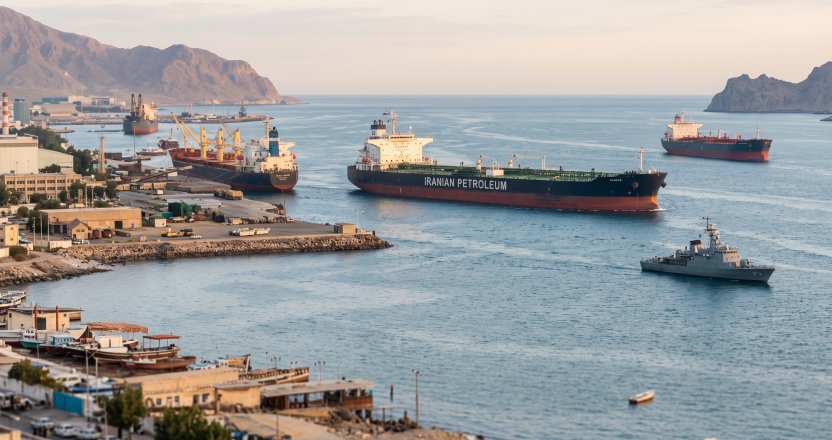
4 min | 30 April 2026
Iran, Hormuz and the energy market: where do we stand at the end of April 2026?
The disruption around the Strait of Hormuz led in March to the largest disruption in the history of the world oil market. Where do we stand at the end of April?
Read more
3 min | 20 March 2026
Newsletter March 2026
A team update, the impact of solar panels and batteries, the new SPRILA round and the tension around the Strait of Hormuz.
Read moreA first conversation works best over the portfolio you already have.

Bring twelve months of invoices for one entity. In 45 minutes we will show you what coordinated procurement under one mandate would change. No deck. No proposal.