Solar farms and Power Purchase Agreements: how attractive is this combination?
4 min | 26 November 2025
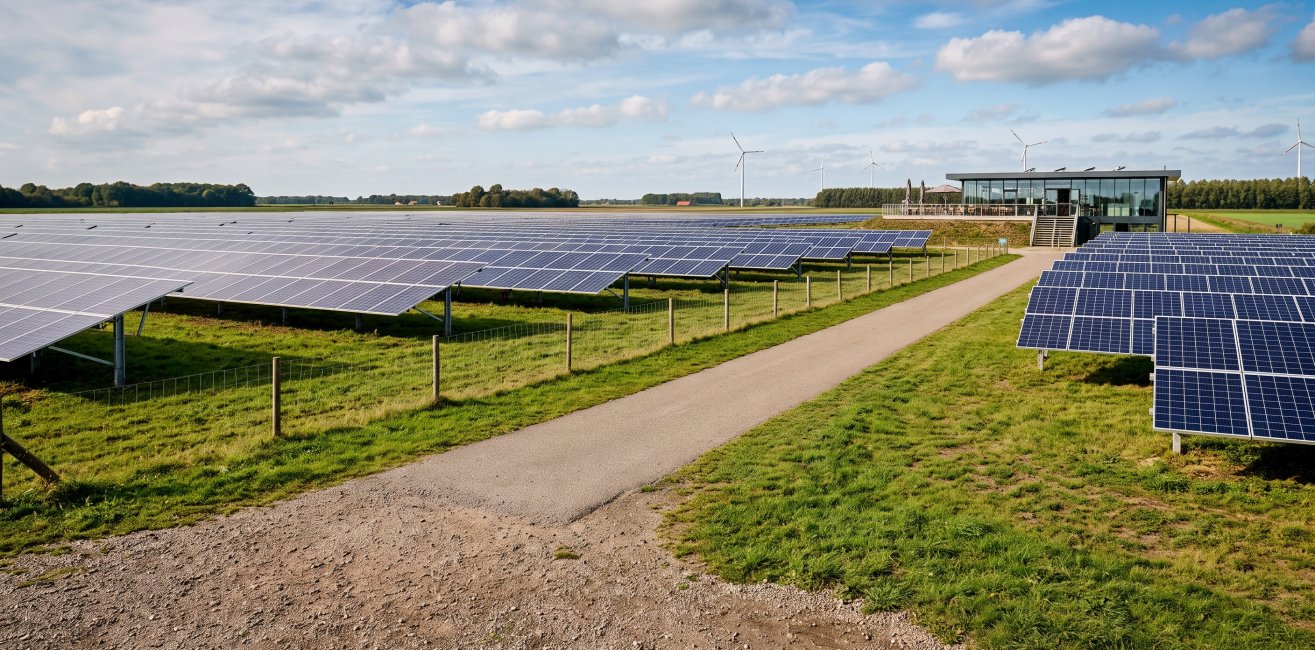
What is a PPA, exactly?
A Power Purchase Agreement (PPA) is a long-term contract under which your business buys power generated directly by, for example, a solar farm. Contracts like these look attractive because they offer a fixed price for renewable energy, often a few cents below the current supply price. Hospitals and large healthcare institutions in particular are approached, because they consume a great deal of electricity and have the heavy grid connections that are very interesting to solar farm developers at a time of grid congestion.
A low price, but are you comparing like with like?
The power you buy through a PPA is only delivered when the sun shines, at moments when there is already an abundance of solar power. Market prices in those hours are structurally lower and increasingly even (slightly) negative. The average value of solar power in these hours sits at roughly 4 to 5 cents per kWh across 2024 and 2025, clearly below the average day price. So if you are paying 8 to 11 cents per kWh for power that the market prices considerably lower, you either have to place a high value on additional sustainable generation, or make a very good case for why you are not choosing an alternative form of green procurement.
The real costs sit in the expensive hours
Something else matters here: you only pay that PPA price for the solar farm's output. For the other 70 to 80 per cent of your electricity consumption, above all in winter, in the evening and at night, you still have to buy power from an energy supplier. Often that happens (partly) at hourly prices on the short-term market, or through products in which those risks have been priced in. Those are precisely the hours in which prices are most volatile and can rise sharply. Without proper hedging, a long-term PPA contract can therefore make your total costs less predictable rather than more.
There are ways to buy the residual profile (partly) from an energy supplier at a fixed price. Suppliers charge a premium for this, however, to cover profile and imbalance risk, and in practice that can run to several cents per kWh on top of your bare supply price. A fully fixed all-in price combined with a PPA is therefore possible, but it usually sits clearly higher than a standard fixed contract without a PPA.
As produced or as nominated: who carries which risk?
If you want to reduce the risk for yourself or for your supplier, it helps to know that there are broadly two types of PPA. Under an 'as produced' PPA you take the power exactly as the solar farm generates it, so your profile follows the sun. Under an 'as nominated' or 'as forecasted' PPA you agree volumes per period in advance. That gives more predictability and makes it easier to place your residual profile with a supplier, but the price is generally higher and penalty or bonus arrangements may apply if you deviate.
Cheap and negative price moments are a significant risk too
On top of that, under both as produced and as nominated PPAs you are obliged to take the power generated or nominated. If your actual demand is lower than production, you have to sell the surplus back on the short-term or imbalance market. With the number of hours with negative prices in the Netherlands rising steeply, that risk is real: you can end up paying to get rid of your surplus while continuing to pay your fixed PPA price to the solar farm operator.
Social responsibility versus financial considerations
Some organisations deliberately choose a PPA because they value additional renewable generation and visible impact. That is legitimate, certainly for healthcare institutions with strong social ambitions. But the rapid growth of solar energy has pushed down the market value of solar power in peak hours, and average PPA prices in Europe fell considerably in 2025. Anyone considering a PPA today therefore has to look especially closely at the price level, how risk is allocated and how the residual profile is hedged.
What does remain worthwhile: solar panels on your own roof
A PPA is usually not the first choice if your primary aim is financial optimisation. Solar panels on your own roof, coupled to direct self-consumption, remain a robust step for many hospitals and large users: you structurally reduce your purchased volume, avoid network and tax components on those kWh, and can optimise your profile further with storage or flexibility.
Related insights
3 min | 13 July 2026
The green gas blending obligation: what is coming your way?
The Netherlands is introducing a blending obligation: energy suppliers will have to deliver an annually rising share of green gas. What does that mean for your invoice?
Read more
6 min | 15 June 2026
The energy market: where do we stand in mid-June 2026?
Price falls can reverse within a short time, while geopolitics, stocks and supply routes continue to steer the market. The key signals at a glance.
Read more
4 min | 30 April 2026
Iran, Hormuz and the energy market: where do we stand at the end of April 2026?
The disruption around the Strait of Hormuz led in March to the largest disruption in the history of the world oil market. Where do we stand at the end of April?
Read moreA first conversation works best over the portfolio you already have.

Bring twelve months of invoices for one entity. In 45 minutes we will show you what coordinated procurement under one mandate would change. No deck. No proposal.